


You are here: Home / Additional modules / Statistics toolkit / Use statistics / Work with statistics / Statistics with Stored Values

€

Statistics toolkit

Statistics with Stored Values
Several examples will be used to explain how to use statistics and how they can be changed via the configuration. There are several example pages for this under “Working with statistics“.

Another example is statistics with stored values.

It is currently possible to determine how many of the currently active contacts have a start date in month XY. How many were active in month XY? How many are archived? How many prospective renters or prospective buyers were there, how many owners… ? The status of a contact or property is a property that is intended to change; therefore, in addition to the status itself, the time at which that status was set must also be recorded. This information must also be stored for the analysis.

The solution to this is “Statistics for Stored Values.” These statistics are specific and unique, so there are no standard templates for them.

Statistics with saved values can only be created by administrators. Users without administrator rights can use such statistics only by using a template with “Monthly saved values” previously provided by an administrator.

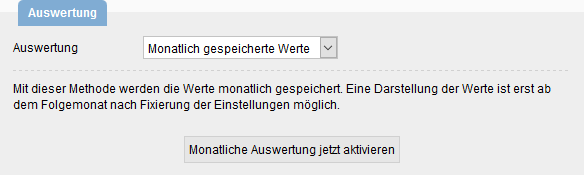
The setting for “Statistics with Saved Values” can be found in the Statistics Configuration under the “Analysis” category. Select “Monthly Saved Values” there.

Please note: The stored numbers thereby capture all records that can be accessed by the user who created the statistics. If you save the statistics as a template, all users of the template can evaluate the saved figures. In this case, a user may be able to analyze data for a larger number of records than the user is actually supposed to see. Since the data records behind the numbers were not saved, no user can access the locked data records; they only see numerical values that they would otherwise be unable to access.

The key figures for these statistics are collected and stored at the end of each month. Therefore, when you create this type of report, you won’t be able to see the first figures until the following month. Retroactive evaluation is not possible.

The key figures are stored as a pure number, no assignment to the data records from which these key figures originate is possible anymore. Therefore, clicking on the values in the table does not open a search result window with matching records.

Statistics toolkit